

You return to your car after a few quiet weeks, turn the key, and hear a weak click instead of a confident crank. Nothing obvious happened. The lights were off, the doors were locked, and the battery worked perfectly the last time you drove. Yet a parked vehicle can slowly lose charge through its own electronics, while an undercharged lead-acid battery becomes increasingly vulnerable to sulfation.
A battery tender for a car is designed for that exact situation. It doesn't act like a jump starter, and it isn't a charger that pushes current forever. A proper maintainer checks the battery, restores charge when needed, then holds it at a controlled maintenance level. The important question is whether your battery needs maintenance, recovery, or replacement.
Table of Contents
- Why Your Car Battery Dies When You're Not Looking
- What a Battery Tender Actually Does
- The Chemistry Behind Why Tenders Work
- When a Battery Tender Is the Right Tool
- How to Use a Battery Tender Safely
- Common Misconceptions About Long-Term Charging
- Choosing the Right Tender for Your Vehicle
Why Your Car Battery Dies When You're Not Looking
Your weekend car may sit in the garage between drives. A remote worker's commuter may move only for short errands. A snowbird may leave a vehicle untouched while traveling. In each case, the owner expects the battery to wait patiently, but the car continues using small amounts of power for security systems, computer memory, keyless-entry functions, and other standby electronics.
That background consumption is called parasitic draw. It can be too small to notice on one evening and still matter after extended storage. The alternator only replenishes the battery while the engine runs, and short trips may not replace the energy used during starting and parking.
The battery also loses charge naturally over time. Once a lead-acid battery remains undercharged, chemical changes begin to reduce its ability to accept and deliver energy. This is sulfation, the buildup of lead sulfate on the plates. The longer the battery sits below a healthy charge level, the harder it becomes for an ordinary start or brief drive to restore it.
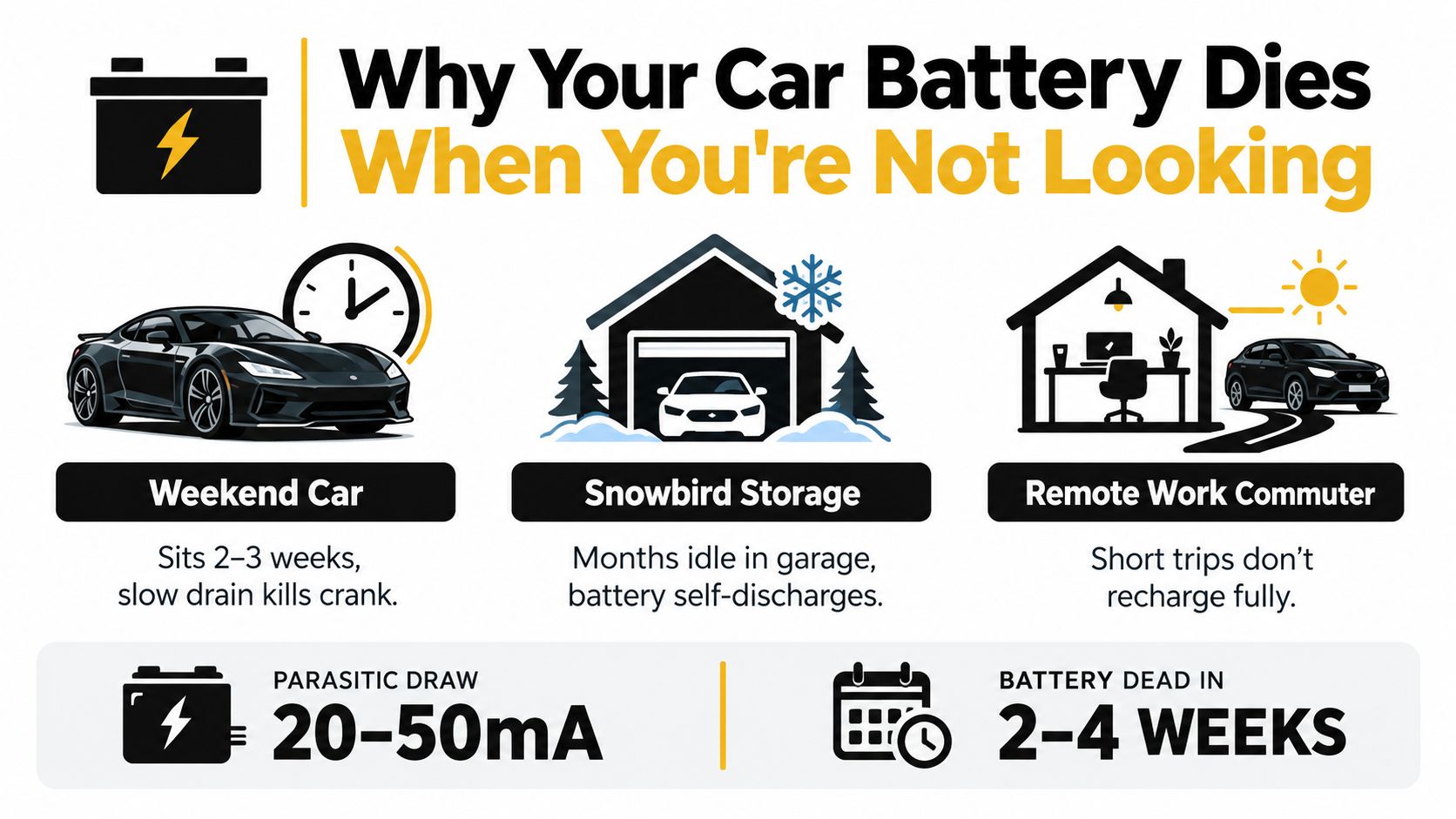
The quiet drain behind a no-start
A tender prevents the battery from spending long periods in that undercharged condition. It supplies controlled energy as the battery needs it, rather than waiting until the next drive begins with a sluggish crank.
Before connecting one, check the battery's resting condition with a 12V digital car battery tester. Testing helps separate a battery that needs maintenance from one that has already developed a fault.
Practical rule: A tender protects a battery that still has usable health. It can't repair a cracked case, an internal short, or a battery that has already lost most of its capacity.
The U.S. Department of Energy's guidance on lead-acid battery maintenance and service life identifies several habits that affect longevity, including matching the charger to the battery, avoiding overdischarge, maintaining electrolyte condition, keeping the battery clean, preventing overheating, and using appropriate equalizing charges where applicable. A maintainer addresses the charge-related part of that routine, but it doesn't replace inspection or correct every storage problem.
What a Battery Tender Actually Does
A battery tender is a smart maintenance charger. It measures the battery's condition and changes its behavior instead of delivering the same current continuously. The exact sequence varies by model, but the operating idea is straightforward.
First comes the bulk stage. The tender supplies charging current to raise the battery from a low but recoverable state. During absorption, it holds the charging voltage while current gradually tapers. Once the battery reaches a full state, the tender moves into float mode. It holds lead-acid batteries in a controlled range of about 13.2 to 13.8 volts, as described in this explanation of float-charger operation.
Some maintainers also use brief monitoring pulses. Think of the process as topping off a water tank with a valve that opens only when the level falls. The tender isn't trying to force more water into a full tank. It's compensating for slow leakage.
Three devices with different jobs
| Feature | Battery Tender | Trickle Charger | Standard Charger |
|---|---|---|---|
| Main purpose | Maintain a healthy battery during storage | Deliver a small, continuous charge | Refill a discharged battery |
| Charging behavior | Adjusts current and transitions to float | May continue charging without smart regulation | Usually provides a stronger charging cycle |
| Long-term connection | Suitable only when chemistry and instructions match | Risky unless specifically regulated | Intended mainly for charging sessions |
| Best use | Stored cars, seasonal vehicles, and intermittent use | Short supervised top-offs on compatible batteries | Recovery after a no-start or deep discharge |
A dumb trickle charger can keep feeding energy after the battery is full. Over time, that may raise the electrolyte temperature, encourage gassing, and damage the plates. A standard charger is better for recovery because it is built to put meaningful charge back into a depleted battery, but it isn't automatically appropriate for indefinite connection.
The decision is simple. If your goal is to refill a battery that won't start the car, use a charger or arrange a proper diagnosis. If the car still starts and will sit unused, a matched tender is the more suitable tool.
The Chemistry Behind Why Tenders Work
A lead-acid battery works a little like an energy bar with a narrow healthy range. A fully charged battery typically rests around 12.6 to 12.8 volts, while a lower resting voltage indicates that less usable charge remains. Voltage isn't a perfect capacity gauge by itself, because temperature, recent charging, and surface charge affect the reading, but it gives you a useful starting point.
Sulfation is the chemical equivalent of a slow, stubborn crust forming where you need a clean contact surface. When a lead-acid battery remains undercharged, lead sulfate crystals form on its plates. Some can be converted during normal charging, but prolonged undercharge allows deposits to harden and limits the plate area available for the next start.
One independent maintenance guide identifies sulfation as responsible for nearly 80% of lead-acid battery failures and recommends charging after use, avoiding storage at low charge, and using temperature-compensated charging in high heat. You can review that guidance in this lead-acid and AGM battery maintenance reference.
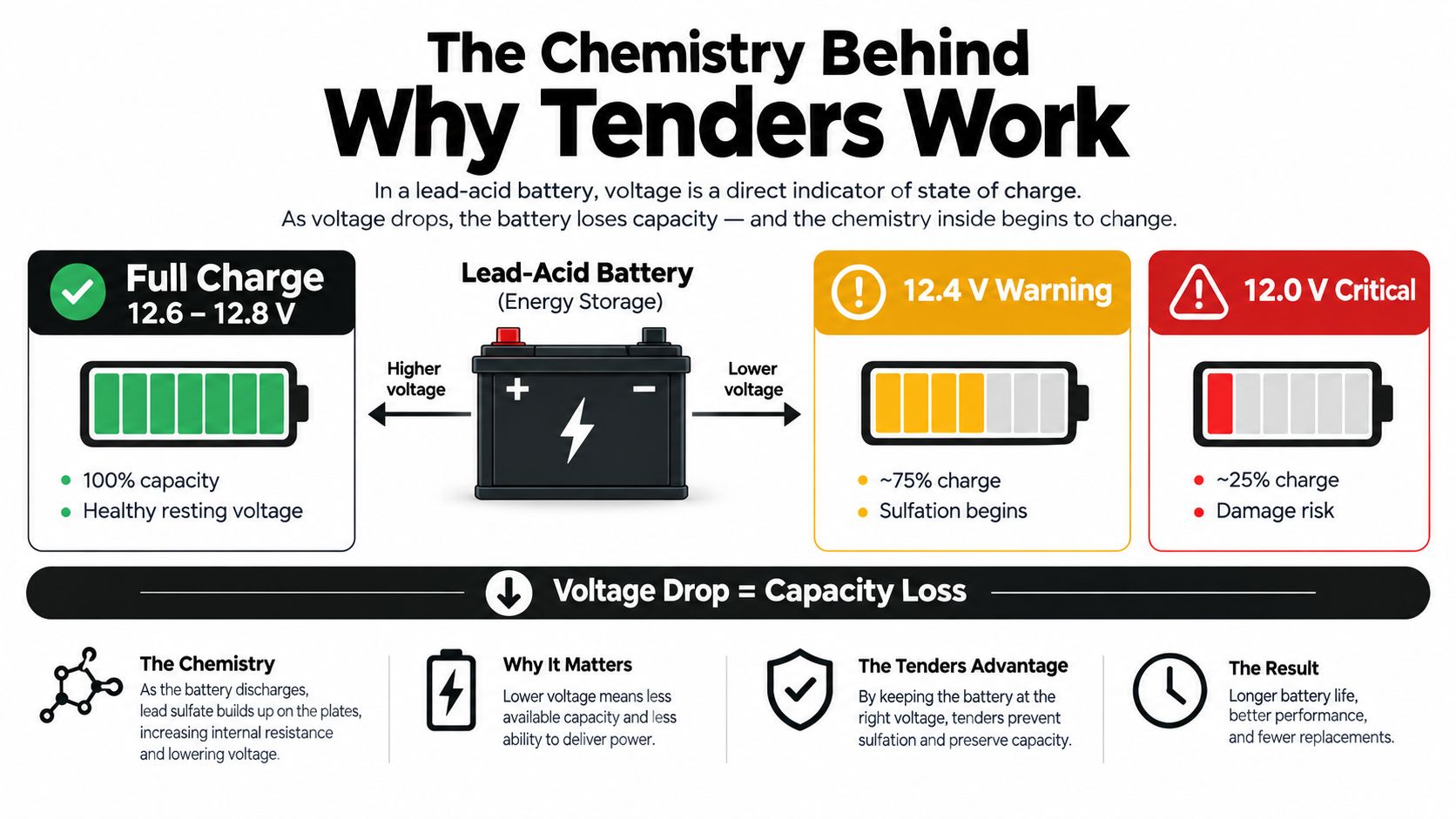
Why the float range matters
Float voltage is the controlled top-off, not a second bulk charge. For a typical 12V lead-acid battery, the useful maintenance range is around 13.2 to 13.8V. Holding below that range may allow gradual undercharge, while holding above it for long periods can increase the risk of gassing, venting, or drying the battery.
AGM batteries are sealed lead-acid batteries with different charging preferences. They often need a carefully regulated absorption level and may specify a float point near 13.4 to 13.6V at 25°C, according to the cited float-charging guidance. Gel batteries also require a compatible profile, because excessive voltage can damage their electrolyte structure.
LiFePO4 batteries are a separate category. Their internal chemistry and charging requirements differ from lead-acid, AGM, and gel batteries. A lithium battery needs a maintainer that explicitly supports LiFePO4, not a lead-acid tender with a similar connector.
When a Battery Tender Is the Right Tool
The best use case isn't defined by the battery brand. It's defined by how the vehicle spends its time.
A collector car that leaves the garage for occasional drives can lose charge between outings. The same applies to a seasonal motorcycle, RV, boat, or classic vehicle. These batteries may remain idle long enough for normal self-discharge and the vehicle's standby electronics to reduce their reserve.
Low-mileage commuters face a different version of the problem. If most trips are short, the alternator may restore some energy without fully replacing what the starting system and onboard electronics consumed. A tender can keep the battery ready between trips, especially when the car is parked for long stretches.
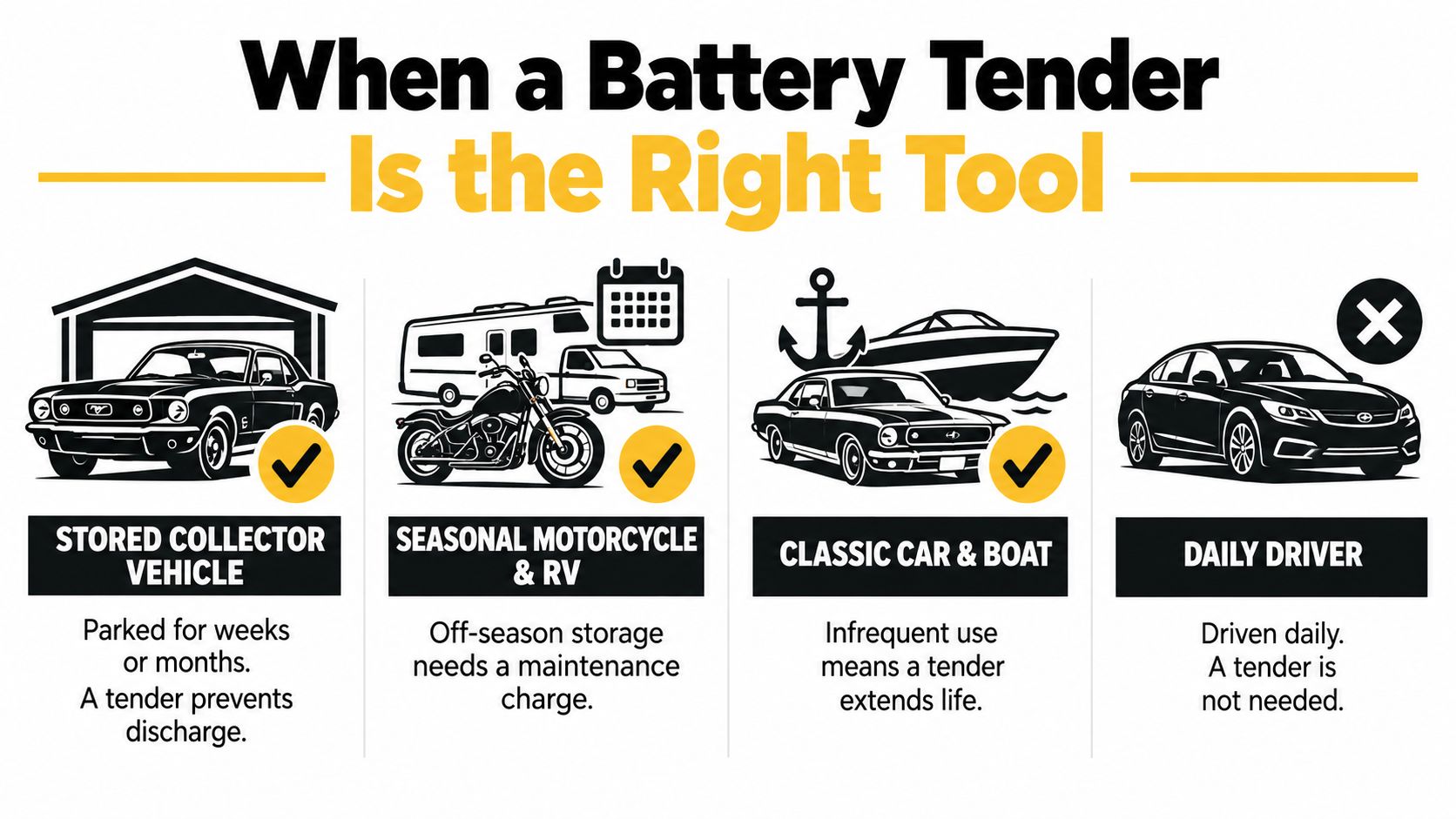
Match the tool to the symptom
Use a tender when:
- The engine still starts: The battery has enough health to maintain, even if the vehicle won't be driven regularly.
- Storage lasts for weeks or months: A regulated float stage helps offset gradual charge loss.
- The car has intermittent use: A maintainer keeps readiness from depending on the next long drive.
- The battery is visibly sound: Clean terminals and an intact case provide a reasonable starting point.
Don't treat a tender as the first response when:
- The car won't crank: A jump starter can provide immediate starting assistance, while a charger can restore the battery more thoroughly.
- The battery is discharged: A maintainer may not have the output or recovery logic needed for a battery far below usable charge.
- The case is swollen, cracked, or leaking: Stop and replace or professionally assess the battery.
- The vehicle has an unexplained drain: Find the electrical fault, or the tender may spend its time compensating for a problem that remains active.
If the car won't start, read this guide on what to check when a portable jump starter isn't charging. A tender preserves a viable battery. It isn't a substitute for diagnosing a failed battery or a vehicle that keeps drawing power.
If the car still starts, maintain it. If it doesn't, diagnose it before you maintain it.
How to Use a Battery Tender Safely
Start with the vehicle switched off and the ignition key removed. Inspect the battery before connecting anything. A damaged case, leaking electrolyte, heavy corrosion, or loose terminal should be addressed before charging.
For a temporary connection, keep the tender unplugged from mains power while attaching the leads:
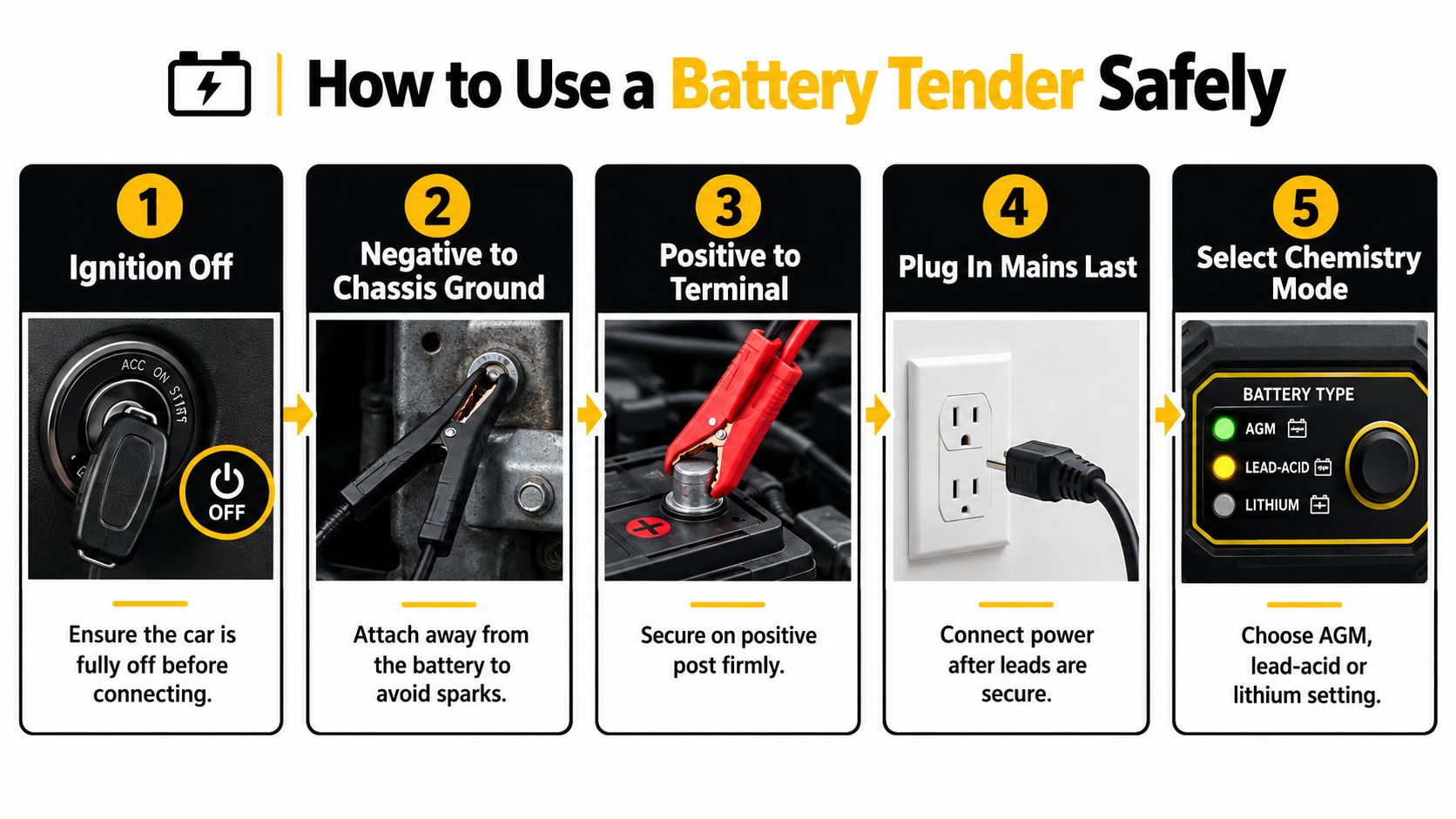
- Connect positive first. Attach the red lead to the battery's positive terminal.
- Choose a ground point. Attach the negative lead to a clean, unpainted chassis or engine ground away from the battery when the manufacturer's instructions permit it. This helps keep any connection spark away from the battery.
- Check the grip. Both connections should be firm and contact bare metal.
- Plug into mains last. Only energize the tender after the vehicle-side connections are secure.
- Select the chemistry mode. Choose flooded lead-acid, AGM, gel, or LiFePO4 according to the battery label and tender instructions.
A ring-terminal harness is usually more secure for a stored vehicle because it stays attached to the battery and provides a quick connector for the maintainer. Alligator clips are convenient for a short, supervised charging session, but vibration or a bumped cable can loosen them during long storage.
Account for chemistry and temperature
A 12V tender isn't automatically universal. Flooded lead-acid, AGM, gel, and LiFePO4 batteries require different charging profiles, so select a model that names your chemistry or provides the correct setting. A lead-acid-only tender shouldn't be connected to a lithium battery because both systems use 12 volts.
Temperature also changes the safe float target. AGM guidance recommends reducing float voltage as temperature rises, by roughly 18 millivolts per °C above 25°C, as described in this temperature-sensitive maintainer guidance. Place the charger in a dry, ventilated location, keep it away from exhaust heat, and follow the manufacturer's outdoor-use instructions.
Watch the status indicator after connection. A light showing float or maintenance mode means the tender has moved beyond active charging. A persistent fault, alternating warning pattern, or failure to progress can indicate low battery voltage, poor contact, wrong polarity, or a battery that needs testing.
Before unplugging, disconnect mains power. Then remove the negative connection first and the positive connection second. Store the leads where clamps won't contact metal, collect moisture, or corrode.
Use this visual walkthrough before your first installation:
Common Misconceptions About Long-Term Charging
The word “charger” covers devices with very different behavior. A basic trickle unit may continue delivering current after the battery reaches full charge. A true smart tender monitors voltage and changes stages, but it still needs the correct chemistry profile and a sound battery.
That distinction matters most during storage. Leaving an unregulated trickle charger attached for months can overcharge a lead-acid battery, encourage electrolyte loss, and create heat. A regulated tender is designed to reduce or interrupt current after charging, then compensate for normal losses at float level.
Long-term methods side by side
| Method | Float Control | Safe Indefinitely? | Best Use Case |
|---|---|---|---|
| Unregulated trickle charger | None or limited | No, unless the instructions specifically allow it | Short, supervised top-off |
| Standard automatic charger | May taper or stop | Not automatically | Recovering a discharged battery |
| Chemistry-matched smart tender | Yes, with monitoring and float control | Only when the manufacturer permits it | Long-term storage and maintenance |
| Jump starter | Not a charging system | No | Immediate roadside restart |
Lithium introduces another common mistake. LiFePO4 batteries need a lithium-compatible tender, and the manufacturer may specify different float behavior or no extended float stage. A lead-acid setting can use the wrong voltage profile and may damage the battery or leave it improperly charged. The Battery Tender FAQ on battery compatibility highlights the need to choose a maintainer that explicitly supports the chemistry.
Some newer products combine maintenance charging with jump-start capability. That hybrid can suit a driver who wants one device for storage upkeep and occasional emergency starting, but the two functions remain different. The maintainer protects a parked battery over time. The jump-start circuit supplies a short burst when the engine must crank now. Neither function fixes a battery with a failed cell or an unresolved parasitic drain.
“Automatic” doesn't mean “compatible with every battery.” Read the chemistry label before leaving any device connected.
Choosing the Right Tender for Your Vehicle
Start with the battery label, not the marketing name. Confirm that the tender supports the battery's voltage and chemistry. A selectable model can be useful if your household includes both AGM and LiFePO4 vehicles, while a fixed-profile unit may be simpler when you maintain one conventional lead-acid car.
Then consider how and where the vehicle is parked:
- Garage storage: A compact low-current maintainer is often practical for a healthy car that sits between drives.
- Outdoor parking: Look for weather protection, sealed construction, and a cable arrangement that won't lie in standing water.
- Hard-to-reach battery: A ring-terminal harness makes repeated connection easier than opening the battery compartment each time.
- Several vehicles: A multi-bank system may be more convenient than moving one charger from car to car.
- Uncertain battery condition: Choose a model with diagnostic indicators, but test the battery separately when the vehicle has a no-start problem.
Current capacity should fit the battery and the job. A small maintainer is intended to offset storage losses, not rapidly recover a heavily discharged truck or RV battery. Larger vehicles or depleted batteries need a charger selected for recovery, followed by a lower-current maintenance mode once the battery is healthy.
Useful features include reverse-polarity protection, temperature compensation, a clear float indicator, and a desulfation or recovery program when the manufacturer explains how it works. Bluetooth monitoring can be convenient, but it isn't essential for most car owners. Reliable chemistry selection and proper voltage control matter more than app notifications.
Before buying, answer three questions:
- What chemistry is installed? Lead-acid, AGM, gel, or LiFePO4?
- Where will the vehicle sit? Dry garage, unheated space, or outdoors?
- How often will you drive it? Daily, occasionally, or only seasonally?
For a straightforward 12V maintenance option, compare the specifications of this portable automatic smart battery charger and maintainer with your battery manufacturer's requirements. The right choice is the one that matches the chemistry, supports the storage environment, and performs the job you need.
TrentonChoice offers practical 12V battery support, including a portable charger and maintainer for ongoing upkeep and a jump starter for no-start emergencies. Visit TrentonChoice to compare those automotive accessories alongside straightforward household products, with published shipping and returns information before you order.
Authored using Outrank tool